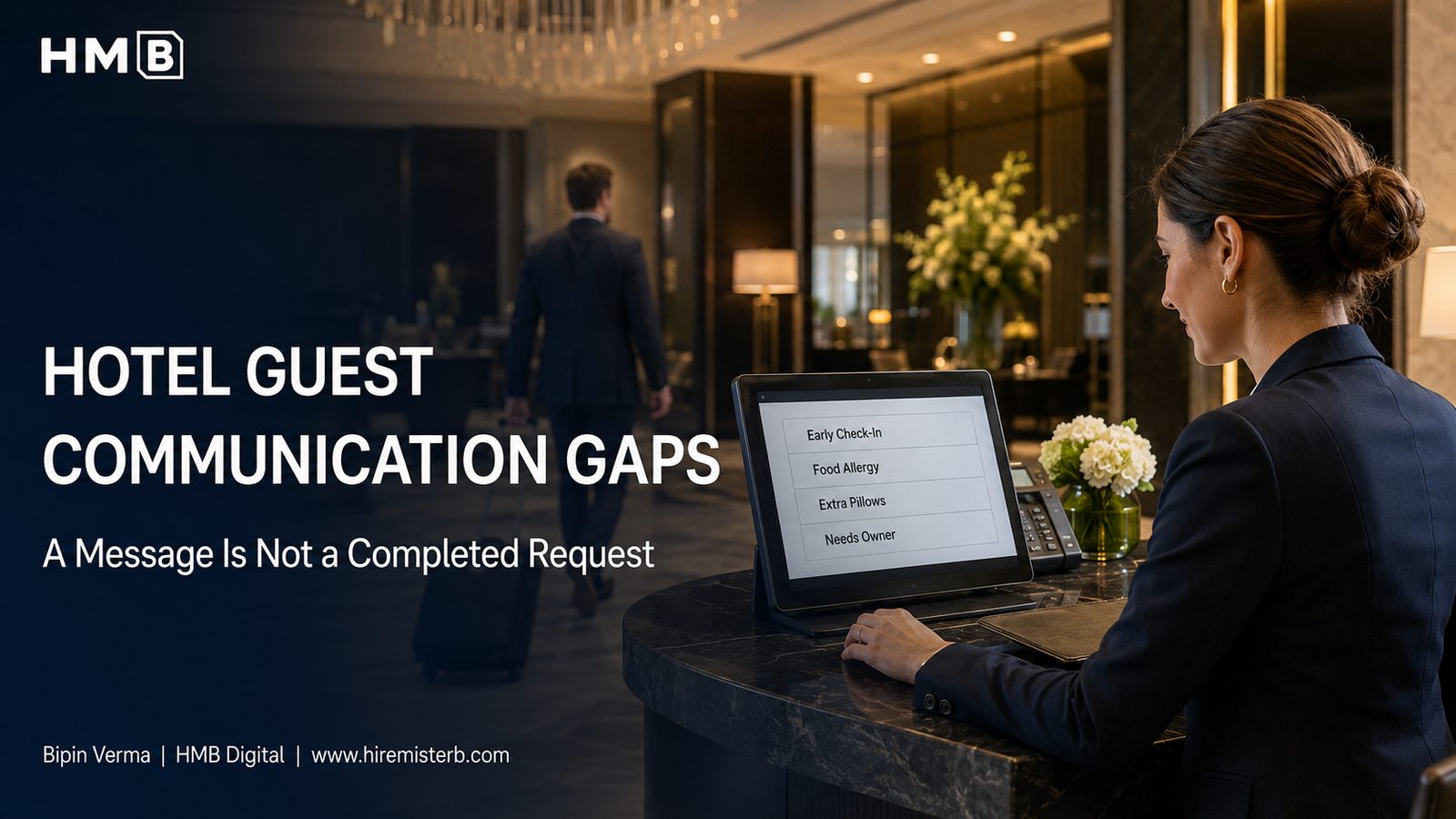
A guest books a weekend stay to celebrate an anniversary.
Three days before arrival, she sends a message through the booking platform. She asks whether an early check-in is possible, mentions a food allergy and requests two extra pillows.
The hotel replies within ten minutes: “Thank you. We have noted your requests and look forward to welcoming you.”
The response is polite and fast. From the guest’s point of view, everything is arranged.
At the hotel, the message remains in the reservations inbox. Reception does not know about the early arrival. The restaurant does not receive the allergy information. Housekeeping prepares the room with the standard pillow setup.
When the guest arrives, the room is not ready and the requests have to be explained again.
The hotel answered the message. It did not complete the request.
This distinction matters. Hotels now communicate through direct websites, booking platforms, email, telephone, text messages, social channels and mobile applications. A fast response can create confidence, but that confidence disappears when the operational team has no record of what was promised.
A hotel guest communication system should do more than collect conversations. It should connect every service request with the correct reservation, department, deadline, status and completion record.
This guide explains where guest communication breaks down and how hotels can build a practical workflow from the first message to the final service outcome.
Why Guest Communication Has Become an Operational Issue
Guest communication is no longer limited to a telephone call with reception.
A traveler may discover a hotel through Google, book through an online travel agency, ask a question on the hotel’s website, send arrival details by email and contact reception through a messaging service during the stay.
The 2026 Revinate Hospitality Benchmark Report examines billions of emails, millions of calls, millions of text messages and millions of public reviews. An industry discussion of the report stated that hotels receive more than 1,000 guest text messages per month on average globally.
Public feedback adds another layer. Shiji’s Q2 2026 Guest Experience Benchmark found that Booking.com and Google produced more than 62% of the global review volume in its dataset. A request that fails inside the hotel can become a public account of the stay.
This is why guest communication should not sit outside hotel operations. It affects service delivery, reputation, revenue and the chance of a future direct booking.
A Reply and a Completed Request Are Different Things
Hotels often measure response time. That is useful, but it answers only one question: how quickly did we reply?
The guest cares about a second question: did the hotel do what it said it would do?
A complete guest request has at least six parts:
- 1The hotel receives the message.
- 2The request is linked to the correct guest and reservation.
- 3The request is understood and given a priority.
- 4A person or department takes ownership.
- 5The requested action is completed or a clear alternative is offered.
- 6The guest receives confirmation.
Many systems handle the first step. The operational risk usually appears between steps two and six.
Where Hotel Guest Requests Get Lost
1. Messages arrive in separate inboxes
Reservations may manage booking-platform messages. Reception handles telephone calls and in-person questions. Marketing receives website forms and social messages. The restaurant manages dining requests. Housekeeping uses another system or a daily task sheet.
Each channel may work correctly on its own, but the hotel lacks one view of the guest’s active requests.
2. The message is not linked to the reservation
A guest may use a different email address or telephone number from the booking record. A booking platform may hide personal contact details. A family member may send the request while another person made the reservation.
Without a reliable match, staff may create a note that never appears when the guest arrives.
3. The hotel acknowledges before confirming
Service teams want to respond quickly, so they may say that a request has been noted before checking availability or department capacity.
For an extra pillow, this may be low risk. For an airport transfer, accessible room requirement, allergy or paid upgrade, an unconfirmed promise can create a serious failure.
4. Nobody owns the next action
“Noted” is not an owner. A useful record should show whether reception, housekeeping, food and beverage, maintenance, transport or another team is responsible. It should also show who needs to respond when the request crosses departments.
5. Shift changes break the chain
Hotels operate around the clock. A request may arrive during the evening shift, require action in the morning and affect a guest arriving in the afternoon.
If the information remains in a personal inbox, notebook or chat, the next shift may never see it.
6. Completion is assumed
A department may mark a task as accepted without confirming that it was completed. Reception sees that housekeeping received the pillow request, but nobody confirms that the pillows reached the room. Acceptance and completion need different statuses.
7. The guest has to repeat the request
Repeating information is frustrating because it tells the guest that the earlier conversation had no operational value. It also increases the chance of error when the new explanation differs from the original message.
The Business Impact of a Broken Communication Chain
Lost guest trust
A guest plans around the hotel’s confirmation. When the request is missed, the guest believes the hotel made a promise and forgot it.
More pressure on front-line staff
Reception must solve the issue at the busiest moment. Staff search message history, call departments and explain why the request was missed.
Missed revenue
Room upgrades, airport transfers, breakfast, parking, late checkout and spa bookings can create revenue. Slow routing can lose both the sale and the guest’s confidence.
Inconsistent service across channels
Policies, availability and pricing become inconsistent when teams work from different information.
Public reputation risk
Private service failures can become public reviews that influence future travelers.
Weak management visibility
Without a shared record, leaders cannot see delays, overloaded departments or service demand.
A Practical Hotel Guest Request Workflow
The system should follow the guest request from message to outcome.
| Stage | Required action | Useful system support |
|---|---|---|
| 1. Receive | Collect the message from the available channel | Shared inbox or channel connection |
| 2. Match | Link the request with the guest, reservation and stay dates | PMS lookup and identity confirmation |
| 3. Understand | Record the requested service, details and guest expectations | Structured request type and clear notes |
| 4. Prioritize | Identify safety, accessibility, timing and service risk | Priority rules and response deadline |
| 5. Assign | Give responsibility to a department and named owner | Department routing and ownership status |
| 6. Confirm | Check availability, price and operating capacity before promising | Internal confirmation and guest response template |
| 7. Complete | Perform the requested action | Department task list and completion evidence |
| 8. Verify | Confirm that the request was fulfilled correctly | Reception review or guest confirmation |
| 9. Learn | Record the outcome and any service recovery | Reporting, reason codes and follow-up |
Every stage should use one request number. The original message, internal task, guest response and completion record should remain connected.
What a Useful Hotel Communication System Should Include
One guest request record
The system should create one record even when a conversation crosses channels. It should show the request, reservation, stay stage, department, owner, deadline and status. Access should follow each employee’s role.
Clear request categories
Categories help the hotel route work and identify patterns. Examples include:
- Check-in and checkout timing
- Room setup
- Housekeeping
- Food allergies and dietary needs
- Transport
- Maintenance
- Accessibility
- Billing
- Celebrations
- Lost property
- Complaints
- Paid upgrades
Notes should support a category rather than replace it.
Priority and deadline rules
Not every request has the same urgency. A request for an extra towel can follow a standard service time. A report of water on the bathroom floor needs faster action. An allergy or accessibility requirement may need management attention before arrival.
Rules can set deadlines based on request type, arrival time, service risk and hotel policy. Supervisors should see overdue tasks.
Department ownership
The system should show who owns the outcome, not only who received the message. When several departments are involved, one person should remain responsible for the complete outcome.
Statuses that reflect real work
Simple statuses are easier to use consistently:
- New
- Needs clarification
- Assigned
- Confirmed with guest
- In progress
- Completed
- Verified
- Unable to complete
- Closed
“Unable to complete” is important. Staff need a clear path to offer an alternative rather than leaving a request open or making an uncertain promise.
Shift handover view
The next shift should see upcoming arrivals with open requests, current guests waiting for service and overdue actions. This view can replace long verbal handovers and reduce dependence on personal memory.
Guest confirmation
When appropriate, a short completion message gives the hotel a chance to solve a problem before checkout.
Systems That May Need to Connect
A hotel guest communication system usually sits between several operating tools.
| System | Information exchanged |
|---|---|
| Property management system | Reservation, guest, room, arrival, departure and stay status |
| Booking engine | Direct booking questions and reservation details |
| Online travel agency channels | Guest messages and booking references where access is available |
| Housekeeping system | Room readiness, cleaning tasks and amenity requests |
| Point-of-sale system | Dining, paid amenities and service charges where appropriate |
| Customer relationship system | Guest preferences, communication history and consent |
| Maintenance system | Fault reports, room issues and repair status |
| Payment system | Approved charges and secure payment requests |
| Telephone and messaging channels | Conversation history and contact details |
The hotel should decide which system owns each type of data and connect only what the workflow requires.
Protecting Guest Information
Guest requests can contain personal and sensitive details. Allergies, accessibility needs, travel arrangements, family information and payment questions require careful handling.
A responsible system should include:
- Access based on job role
- A record of who viewed or changed a request
- Secure connections between systems
- Clear retention periods
- Guest consent where required
- Limited information in notifications
- Secure handling of payment links
- A process for correcting guest details
Staff should see enough information to perform the service, but not more than they need.
A Realistic Example
Consider a guest who requests an airport transfer and early check-in. In a disconnected process, reservations notes the message, emails a transport contact and leaves reception without a confirmed arrival time. The guest lands and staff search through messages.
In a connected process, the transfer becomes a task with flight details, price and assigned provider. Early check-in becomes a separate task because it depends on occupancy and housekeeping. The guest receives driver instructions, while the hotel confirms early check-in or offers luggage storage and facility access.
The technology does not create a room that is not available. It prevents the hotel from promising something before the operating team has confirmed it.
Build, Buy or Connect What You Already Use?
| Situation | Practical approach |
|---|---|
| The current PMS includes request management but teams use separate inboxes | Configure the existing tools, simplify the process and train staff |
| The hotel has several communication channels but no common task record | Add a shared request layer connected to the PMS |
| A hotel group uses different property systems | Create a common workflow and integration layer across properties |
| The hotel has specialist services and unusual approval rules | Build a focused module around the existing operating model |
| The main problem is poor handover rather than missing software | Improve ownership, statuses, shift views and reporting first |
Buying another communication tool will not solve unclear responsibility. Start by mapping the request journey and deciding which team owns every stage. Our travel and hospitality solutions work begins at exactly that point.
A 90-Day Implementation Plan
Days 1 to 30: Map real guest requests
Review a sample of pre-arrival, in-stay and post-stay conversations. Follow each request from the first message to the final outcome.
Record every channel, department, system and handoff. Identify where staff repeat information, make unconfirmed promises or lose visibility.
Days 31 to 60: Configure one pilot
Choose a limited set of high-volume requests, such as early check-in, extra room items, transport and maintenance.
Create the categories, ownership rules, deadlines, statuses, shift view and guest confirmation messages. Connect the PMS and one or two important channels.
Days 61 to 90: Test during real stays
Pilot the process with one property, shift or department group. Track overdue requests, staff adoption and guest follow-up.
Remove unnecessary fields, improve routing and document the operating process before adding more request types or properties.
Metrics That Show Whether the System Is Working
| Metric | What it reveals |
|---|---|
| First response time | How quickly the hotel acknowledges the guest |
| Time to ownership | How quickly a department accepts responsibility |
| Time to completion | How long the service takes from request to outcome |
| Requests completed before arrival | Whether pre-arrival planning is working |
| Overdue request rate | Where service is falling behind |
| Guest repeat-contact rate | Whether guests have to ask again |
| Unable-to-complete rate | Which promises, services or capacity need review |
| Service recovery rate | Whether failures are resolved before checkout |
| Revenue from paid requests | Which guest needs create commercial value |
Response time should not stand alone. A hotel can reply in five minutes and still leave the request unfinished for five hours.
What Technology Cannot Fix
A system cannot create empathy, replace a trained hotel team or provide capacity the property does not have. It will fail when staff use personal channels, departments avoid ownership, service standards are unclear, guest data is poor or leaders measure replies but ignore completion. The process should make responsibility clearer and work easier.
How HMB Digital Can Help
HMB Digital helps hospitality businesses connect customer communication with practical operating workflows. This may include guest portals, shared request systems, mobile staff tools, PMS connections, department dashboards, secure payment links and management reporting.
We can improve an existing process or build a focused application when standard products do not fit the property, service model or hotel group.
Our starting point is a guest-request assessment. We review the channels, systems, departments, handoffs and points where a message stops becoming visible. The result is a phased plan and a pilot focused on measurable service outcomes.
See how HMB Voyage supports travel and hospitality operators, explore our industry software solutions, or contact HMB Digital to discuss a hotel guest communication assessment.
Final Thought
Hospitality is built on small promises. The room will be ready. The transfer will arrive. The allergy will be remembered. The extra pillow will be there.
A hotel should not measure communication only by how quickly it replied. It should measure whether the request reached the right person and whether the guest received the promised outcome.
Frequently Asked Questions
What is a hotel guest communication system?
It is a system that manages guest conversations across available channels and connects service requests with reservations, departments, owners, deadlines and completion records.
How is guest messaging different from request management?
Guest messaging handles the conversation. Request management controls the work created by that conversation. A hotel may need both functions connected in one process.
Does a hotel need to replace its PMS?
Not usually. The PMS can remain the source for reservation, guest, room and stay information. A request system can connect with it and add department workflow where required.
Which guest requests should be included first?
Start with frequent or high-risk requests such as early check-in, late checkout, room items, transport, maintenance, dietary needs and accessibility requirements.
How can hotels manage requests across shift changes?
Use a shared handover view showing upcoming arrivals with open requests, overdue actions, current guest issues and the person responsible for each task.
Should every message become a task?
No. General questions may need only a reply. A task should be created when the hotel must perform, confirm or monitor an action.
What should happen when a request cannot be completed?
Staff should record the reason, inform the guest quickly, offer a suitable alternative and escalate when the request affects safety, accessibility or a significant service promise.
What is the most important hotel communication metric?
Completion is more valuable than response time alone. Hotels should measure both how quickly they reply and how reliably they deliver the requested service.
Share Article
About the Author

Bipin Verma
LinkedInManaging Director
HireMisterB Digital
Bipin leads HireMisterB's strategic vision and enterprise client relationships. With over a decade of experience helping businesses across the US, UK, and India digitise their operations, he believes technology only matters when it creates measurable business value. His background spans product strategy, digital transformation, and building high-performance distributed teams.