
So you’ve got a big idea. You want to build the next Zomato, the next Swiggy, or maybe something even better. You’ve watched these platforms go from scrappy startups to billion-dollar empires, and now you’re wondering — how exactly did they do it? And more importantly, how can you do it too?
The truth is, building a food delivery app is not just a coding project. It’s a full-scale digital product that touches mobile app development, real-time tech, logistics, payment gateways, AI recommendations, and marketing — all woven together into one seamless experience. If done right, it’s one of the most profitable digital ventures out there right now.
At HireMisterB Digital Pvt. Ltd., we’ve helped businesses across industries build full-featured apps from scratch. Whether you’re looking to hire a dedicated full stack developer, hire a React developer, or need an end-to-end tech team to bring your vision to life — we’ve done it all. And in this guide, we’re giving you the honest, step-by-step roadmap to build your food delivery platform.
Let’s get into it.
Step 1: Understand the Business Model First
Before a single line of code is written, you need to understand what kind of food delivery platform you’re building. There are three core models used by the giants:
The Aggregator Model — You list restaurants on your platform and handle the discovery and ordering. The restaurant handles delivery (like early Zomato).
The Logistics + Aggregator Model — You handle both the ordering and the delivery using your own fleet. This is how Swiggy and Uber Eats largely operate today.
The Cloud Kitchen Model — You operate your own kitchens and deliver food directly, without relying on third-party restaurants.
Most successful apps today use the second model — the full-stack logistics plus aggregator approach. This requires more investment but gives you full control of the customer experience.
Understanding your model also determines how complex your tech stack needs to be and how much you’ll need to invest in your development team.
Step 2: Map Out the Core Features
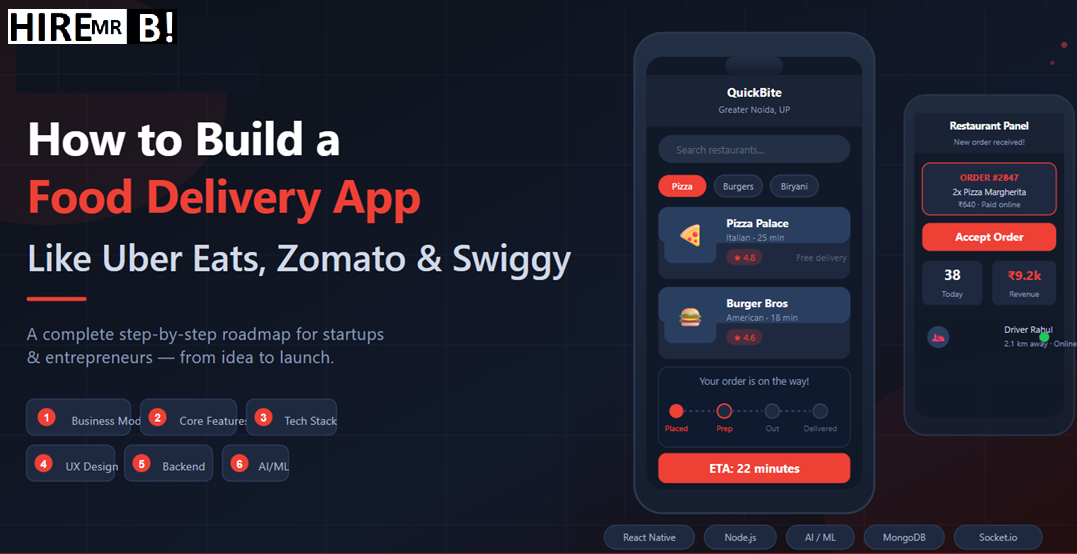
Every great food delivery app is made up of three separate apps talking to each other in real time. Here’s how to break them down:
The Customer App — This is what your end users see and interact with every day. It must include user registration and login (social logins, OTP-based), smart restaurant and dish search with filters, real-time order tracking with map view, multiple payment options (UPI, cards, wallets, COD), ratings and reviews, loyalty rewards and coupon codes, and AI-powered food recommendations based on order history.
The Restaurant/Vendor App — Restaurants need their own dedicated panel to receive and manage incoming orders, update menu items, availability, and pricing, view earnings reports and analytics, and communicate delays or issues in real time.
The Delivery Partner App — Your delivery agents need a clean, lightweight app that lets them accept or reject delivery requests, navigate via GPS with optimized routing, track earnings and manage their profile, and communicate with customers if needed.
All three apps need to sync in real time. A customer placing an order should reflect instantly on the restaurant’s panel, and a delivery agent should be auto-assigned within seconds. This is where your backend architecture becomes absolutely critical.
Step 3: Choose the Right Tech Stack
This is where most startup founders get confused — and where having the right development partner makes a massive difference. Here’s what the best IT companies in the world use for food delivery platforms:
Frontend (Customer & Partner Apps): React Native or Flutter for cross-platform mobile apps (Android + iOS from a single codebase), and React.js for web-based admin panels and dashboards.
Backend: Node.js for real-time, event-driven server-side logic, Express.js or NestJS for API architecture, and Python/Django for data-heavy operations and ML pipelines.
Database: PostgreSQL or MySQL for structured relational data (orders, users, payments), MongoDB for flexible schema-less data, and Redis for caching, session management, and real-time queues.
Real-Time Communication: Socket.io or Firebase Realtime Database for live order tracking.
Cloud & DevOps: AWS, Google Cloud, or Azure for hosting and scalability, and Docker and Kubernetes for containerized deployments.
AI & Machine Learning: Recommendation engines built with Python (scikit-learn, TensorFlow), and predictive ETAs using ML models trained on historical delivery data.
When you hire a Node developer or hire a React developer through a company like HireMisterB Digital, you’re not just getting a coder — you’re getting someone who understands this entire ecosystem and knows how to build it to scale.
Step 4: Design the User Experience (UX/UI)
People don’t just order food — they experience your app. The design of platforms like Swiggy and Uber Eats is obsessively tested and refined. For your app to compete, design cannot be an afterthought.
Key UX principles to follow:
Speed above everything — Users will abandon an app that takes more than 3 seconds to load. Optimize every screen.
One-tap ordering — The fewer clicks between “hungry” and “order placed,” the better your conversion rate.
Visual hierarchy for menus — Use high-quality food photography, clear pricing, and logical category grouping.
Real-time feedback — Order confirmations, live tracking maps, and delivery ETAs should update instantly with no lag.
Intuitive navigation — First-time users should be able to place an order without needing any instructions.
Our UI/UX and website design team at HireMisterB works closely with clients to create wireframes, prototypes, and full design systems before development begins. Getting the design right upfront saves enormous time and cost in later stages.
Step 5: Build the Backend Infrastructure
This is the heart of your application. A food delivery app is essentially a real-time logistics platform, and your backend needs to handle:
Order Management System (OMS) — Tracks the complete lifecycle of every order from placement to delivery. This needs to be bulletproof.
Geolocation & Route Optimization — Integration with Google Maps API or Mapbox to show restaurant locations, delivery routes, and live driver tracking.
Push Notifications — Firebase Cloud Messaging (FCM) to send real-time alerts to customers, restaurants, and drivers at every stage of the order.
Payment Gateway Integration — Razorpay, Stripe, PayU, or PayPal depending on your target market. Needs to handle multiple currencies if you’re going global.
Surge Pricing Logic — Dynamic pricing during peak hours or high-demand areas (similar to how Uber Eats handles busy times).
Admin Dashboard — A powerful back-office panel where your team can monitor all orders, manage disputes, push promotions, and view analytics in real time.
The backend also needs to be built for scale from day one. When you go from 100 orders a day to 100,000, your infrastructure should handle it without going down. This is why many of the best IT companies — including us — recommend cloud-native, microservices-based architecture for food delivery apps.
Step 6: Integrate AI and Machine Learning
This is where the big players have separated themselves from smaller competitors, and it’s increasingly accessible to startups too. Here’s how AI powers today’s food delivery giants — and how you can leverage it:
Personalized Recommendations — Show users restaurants and dishes they’re most likely to order based on their history, time of day, and location.
Predictive Delivery Time — ML models that analyze traffic, restaurant prep times, and driver availability to give accurate ETAs before an order is even placed.
Dynamic Delivery Zone Optimization — AI that automatically adjusts delivery coverage zones based on demand patterns and driver availability.
Fraud Detection — Catch fake orders, suspicious payment activity, or fraudulent reviews before they damage your platform.
Chatbot Customer Support — AI-powered chat to handle common queries (order status, refunds, cancellations) without needing a human agent every time.
At HireMisterB Digital, our AI and machine learning team has built intelligent systems across industries. Integrating these capabilities into a food delivery platform is well within scope — and it’s the kind of competitive edge that makes your platform feel premium from day one.
Step 7: Testing, Quality Assurance & Launch
Before you go live, your app needs to go through rigorous testing across every scenario imaginable. Food delivery apps involve money, real-time logistics, and user trust — bugs are not acceptable. Your QA process should cover:
Functional Testing — Does every feature work as expected across all user types?
Performance Testing — Can your backend handle 1,000 simultaneous orders without slowing down?
Device Compatibility Testing — Does the app work perfectly on both Android and iOS across different screen sizes?
Payment Gateway Testing — Every payment flow — success, failure, refund, partial capture — needs to be tested extensively.
Security Testing — User data, payment information, and business logic must all be protected from vulnerabilities.
Once testing is complete, a phased rollout is usually the smartest approach. Start with a single city or neighborhood. Gather real data. Fix issues. Then expand.
Step 8: Post-Launch — Grow, Retain, and Scale
Launching the app is actually the beginning, not the end. The growth phase is where digital marketing becomes just as important as technology.
Digital Marketing Campaigns — Targeted ads on Google, Instagram, and Facebook to drive app downloads. This is where our digital marketing team at HireMisterB comes in — from SEO and performance marketing to influencer partnerships and email campaigns.
Referral Programs — Give users a discount for every friend they refer. This is low-cost, high-return growth.
Restaurant Partner Acquisition — Aggressively onboard quality restaurants in your target area. More variety means more user retention.
Loyalty Programs — Points, streaks, and subscription models (like Swiggy One) keep users coming back week after week.
Data-Driven Decision Making — Use your app’s analytics to understand what’s working and what isn’t. Double down on high-performing cities, cuisines, and promotions.
Scaling also means scaling your tech. As your user base grows, you’ll need to invest in infrastructure upgrades, more developer capacity, and potentially international expansion. This is where having a long-term IT managed support services partner — not just a one-time dev shop — becomes invaluable.
The Cost of Building a Food Delivery App
Let’s be honest about budget. A basic MVP food delivery app with core features for a single city typically costs between $15,000 to $40,000, depending on your geography, feature set, and team structure.
A full-featured platform with AI recommendations, multiple cities, a dedicated admin panel, and advanced analytics can range from $60,000 to $150,000+.
However, when you hire dedicated full stack developers through a reliable partner like HireMisterB Digital, you get significantly better value than hiring in-house or going through expensive Western agencies. Our India-based expert teams deliver enterprise-grade quality at competitive pricing — with full transparency and milestone-based delivery.
Why Partner With HireMisterB Digital Pvt. Ltd.?
We’re not just another IT company. We’re a team of engineers, designers, marketers, and digital strategists who have built products across food tech, healthcare, fintech, edtech, and more. Here’s what we bring to the table:
Website Design & Development, Mobile App Development, Hire Dedicated Developers (React, Node.js, full stack on demand), Digital Marketing (SEO, PPC, social media, performance campaigns), AI & Machine Learning, Data Science, IoT Solutions, Salesforce Consulting, Microsoft Integration, IT Managed Support Services, and Game Development.
Whether you’re a startup building your first MVP or an established business ready to scale digitally, we have the expertise and the team to make it happen.
Final Thoughts
Building a food delivery app like Zomato, Swiggy, or Uber Eats is absolutely achievable — but it requires careful planning, the right technology choices, and a development partner who genuinely understands both the business and the technical sides of the equation.
The market is still wide open. Tier-2 and Tier-3 cities in India remain underserved. Niche food delivery verticals — organic food, home-cooked meals, diet-specific menus — are exploding. Global markets in Southeast Asia, the Middle East, and Africa are growing rapidly.
Your idea might just be the next big thing in food tech. And we’d love to help you build it.
Ready to start building? Let’s talk.
Visit us at hiremisterb.com — reach out to our team to hire dedicated developers, discuss your project requirements, or get a free consultation on your food delivery app idea.
HireMisterB Digital Pvt. Ltd. — Your trusted technology partner for web, mobile, AI, and digital growth.